

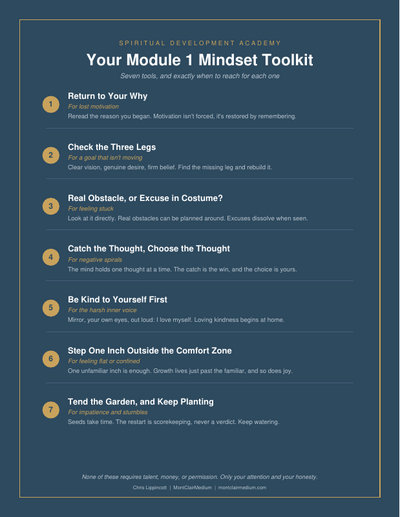
Your Module 1 Mindset Toolkit

Module 1 has given you more tools than you may realize. This page gathers them in one place, in plain terms, so you can find the right one when you need it. Bookmark it, print it for your journal, and come back whenever your mindset needs tending, because it will, and that's not a failure, that's being human.
1. Return to your why
The tool for: lost motivation.
You wrote it in your journal during the welcome module: your real reason for doing this work, and your detailed vision of what you want it to give you. When the practices feel slow or pointless, don't push harder, go back and reread your why. Motivation isn't summoned by force. It's restored by remembering what this is for.
2. Check the three legs
The tool for: a goal that isn't moving.
Every goal you've ever achieved stood on the same three-legged stool: a crystal clear vision of it, a genuine desire for it, and the belief you could reach it. When something you want isn't happening, check the legs. Is the goal vague? Sharpen it until you can describe it in detail. Is the desire weak? Maybe it isn't really your goal. Is the belief missing? That's the leg to work on, because you quietly stop trying long before a goal becomes impossible.
3. Ask: real obstacle, or excuse in costume?
The tool for: feeling stuck.
When something has been "in the way" for a long time, look at it directly and ask the honest question: is this obstacle real, or is it an excuse dressed up as one? Sometimes it's real, and then you can plan around it. Often, seen clearly, it dissolves. Either answer moves you, and not looking is the only option that keeps you stuck.
4. Catch the thought, then choose the thought
The tool for: negative spirals.
Your mind holds one thought at a time, and the thought you dwell in is the one shaping your day. Most negative thoughts run on autopilot, so the skill isn't suppressing them, it's catching them. The catch is the win. And once you've caught one, you're at a fork: you can keep feeding it, or you can choose differently. One small positive thought, chosen on purpose, can turn an entire day. Your gratitude journal is this tool in daily practice, and the thirty-day challenge is its training ground.
5. Be kind to yourself first
The tool for: the harsh inner voice.
You know the voice: should have, shouldn't have, stupid, stupid. I catch it in myself too. Loving kindness begins at home, so when that voice gets loud, go to the mirror, meet your own eyes, and say it out loud: I love you. I love myself. It will feel strange, and then it will make you smile, and the voice softens. You cannot build a spiritual life on a foundation of self-contempt, and you don't have to.
6. Step one inch outside the comfort zone
The tool for: feeling flat or confined.
The ego draws a small circle around what's familiar and calls it safety. Nothing grows inside that circle. When life feels stale, you don't need a transformation, you need one inch: a road you've never driven, a practice you've never tried, a conversation you've been avoiding. Thank the ego for its concern, and take the step. Growth lives just past the familiar, and so does joy.
7. Tend the garden, and keep planting
The tool for: impatience and stumbles.
Your growth is a garden. Seeds don't sprout overnight, and digging them up to check on them only sets them back. So when progress feels slow, keep watering. And when you stumble, and you will, miss a day of gratitudes, lose your temper, restart the challenge for the tenth time, remember that the restart is just scorekeeping, never a verdict. The gardener who keeps planting always ends up with a garden. The one who quits over a failed seed never does.
One last thing. Notice that not one of these tools requires talent, money, or anyone's permission. They require only your attention and your honesty, which means every one of them is always available to you. That's the quiet truth of mindset work: you are never without your tools.
Namaste for now,
Chris

United States